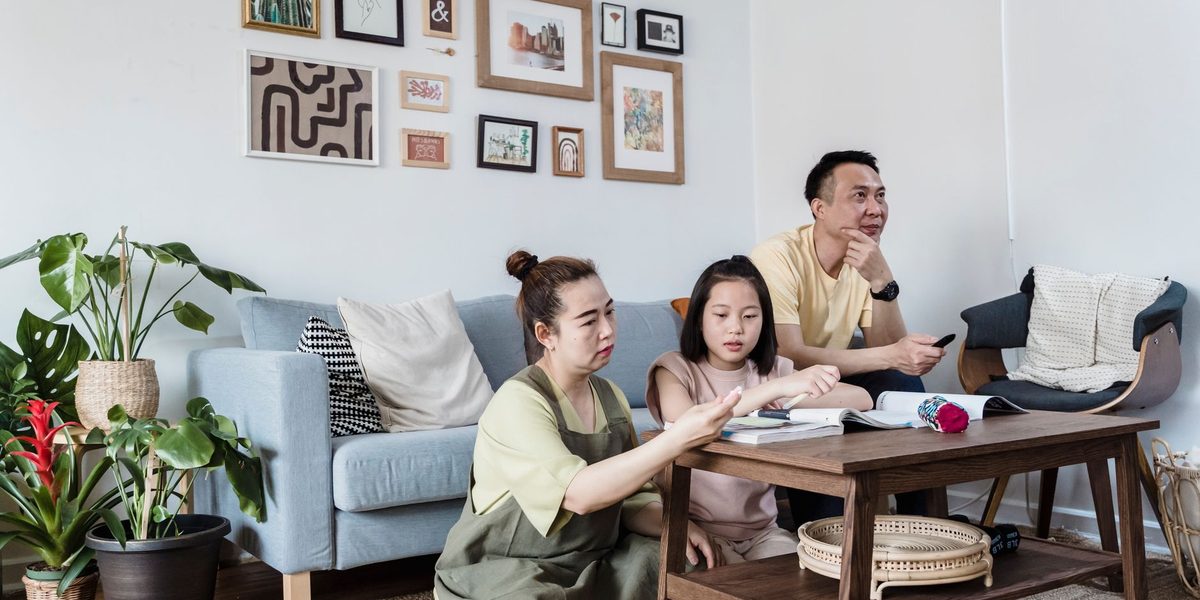
Every family is a collection of incompatible roommates who happen to love each other. One person needs visual calm to relax; another thinks a room is not truly lived in until every surface holds a project. One wants the living room silent for reading; another wants it loud for games. The bedroom is easy — everyone rules their own — but the living room, kitchen, and family room belong to everyone, which too often means they work for no one. Making shared spaces succeed is not about converting the whole family to one standard. It is about designing rooms, rules, and rhythms that let very different people coexist in the same square footage without constant friction.
Name What Each Space Is For
Most shared-space conflict is really a disagreement about purpose that nobody has said out loud. Is the dining table for eating, homework, puzzles, or mail? Is the living room for conversation, television, or floor-level toy empires? When purposes are unspoken, everyone assumes theirs is primary and experiences everyone else as an invasion.
So decide together, room by room: what happens here, and what does not. The decisions can be generous — the dining table can host homework until 5:30 and dinner after — but they must be explicit. A family that agrees the living room floor is fair game for builds-in-progress until Friday cleanup has far fewer arguments than one where a parent silently seethes over scattered bricks all week. Write the outcomes down if your household forgets; a small card inside a cupboard door works fine.
Zone the Room Instead of Policing the People
A single room can serve several masters if you give each use a defined territory. The reading corner gets the good chair, the lamp, and an agreement about noise. The play zone gets the rug and the storage baskets, and toys live inside its borders. The screen zone points the television away from the conversation area if the room allows. Even a small space can hold two or three zones — furniture placement, a rug edge, or a low shelf does the dividing without a single wall.
Zoning changes the conversation from personal criticism to geography. The bricks migrated out of the play zone is a neutral, fixable observation; you always leave your junk everywhere is an accusation with no exit. Children in particular respond to territory rules far better than to tidiness lectures, because the boundary is concrete and the same for everyone.
Give Every Person Storage in Every Shared Room
Clutter in common areas is usually homeless property. The knitting, the console controllers, the homework binder, the dog's toys — they end up on surfaces because their homes are in another room, and the round trip never happens. The fix is local storage: every person who uses a shared room gets a container in that room.
- A basket per family member on the living room shelf for their in-progress items.
- A drawer or bin for each hobby that regularly happens in the space.
- A lidded box for the remote-control-and-cable ecosystem.
- One tray for adult paperwork in transit, emptied weekly.
The rule that makes it work: surfaces are shared, containers are personal. Anything on a shared surface at reset time goes into its owner's container, no questions asked. Nobody's belongings are thrown away or held hostage; they are simply returned to their territory. Resentment drops sharply when tidying means containerize rather than confiscate.
Agree on Reset Points, Not Constant Order
People who need tidiness want the room orderly at all times; people who create freely want their setups left alone. The livable compromise is the reset point: agreed moments when the room returns to neutral, with freedom in between. Common patterns include a nightly reset of the main living space after dinner, a Friday reset of the play areas before the weekend, and an always-clear rule for genuine hazards and food.
Between reset points, the mess is legal. This is the part perfectionists must genuinely honor — no sighing at the Tuesday fort, because Tuesday forts are within the rules. In exchange, the room's free spirits honor the reset without negotiation when it arrives. Both sides get something real: the neat get a guaranteed return to order; the messy get guilt-free space to spread out. The schedule absorbs the conflict so the people do not have to.
Handle Noise Like the Shared Resource It Is
Space conflicts are visible, but sound conflicts cause just as much friction — the video game against the phone call, the practice instrument against the nap, the blender against the meeting. Treat the household's soundscape as a shared resource with its own light rules. Headphones are the great peacemaker; make them the default for personal audio in shared rooms. Predictable quiet windows — homework hour, the baby's nap, an adult's standing call — go on the family calendar so nobody discovers them mid-conflict.
It helps to give loud activities a licensed time and place rather than only restricting them. The drummer who knows exactly when drumming is welcome defends that window and respects its edges. Blanket suppression, by contrast, breeds guerrilla noise and resentment. Like floor space, sound works best when it is scheduled generously instead of contested constantly.
Give the Overstimulated an Exit
Even a well-zoned home overwhelms sometimes, and every family contains at least one person — child or adult — who periodically needs to not be perceived. Make retreat legitimate. A reading chair in a bedroom, a beanbag in an alcove, even a designated quiet hour where the shared rooms go calm: these are pressure valves, and homes without pressure valves route the pressure into conflict instead.
Teach the family to treat retreat as neutral information rather than rejection. The introvert recharging behind a closed door is not sulking; the parent taking twenty minutes alone after work is not angry. Households that normalize this find their shared time genuinely warmer, because everyone present in the common space actually wants to be there.
Revisit the Arrangement as the Family Changes
A shared-space design is a snapshot of who your family is right now, and families do not hold still. The play zone that dominated the living room shrinks as children grow; the homework station matters more each September; a new work-from-home arrangement or a returning college student redraws the whole map. Twice a year, walk the common rooms together and ask what is working, what is contested, and what has quietly stopped being used. Reclaim dead zones, move the friction points, and re-divide the storage.
These check-ins keep resentment from fossilizing. Most shared-space anger is old anger — a rule that made sense two years ago still being enforced, or a need that emerged last spring still unmet. A family that expects the map to change handles the changes as logistics rather than grievances.
Final Thoughts
Shared spaces work when the sharing is designed instead of assumed: purposes named, zones drawn, personal storage provided, resets scheduled, sound and solitude respected. None of it requires a bigger house or a reformed family — pilers stay pilers, minimalists stay minimalists. What changes is the system around them, which quietly converts daily friction into a set of agreements everyone helped write. That is what makes a common room feel common: not that it is always tidy, but that it visibly belongs to everyone at once. Start with the single room that causes the most friction, get its zones and reset point agreed, and let the results recruit the rest of the house.